

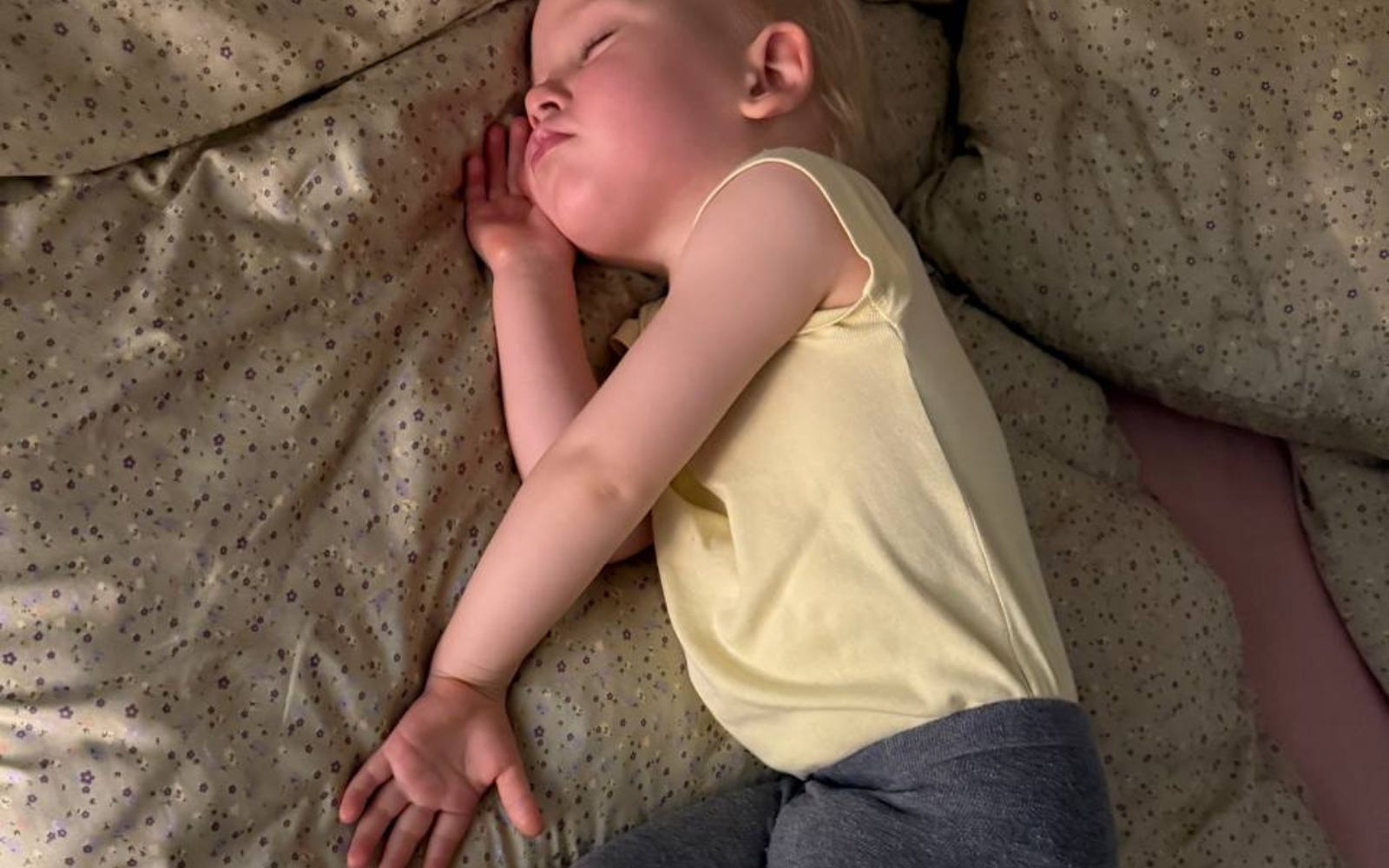
A recent discussion on Charlotte’s Substack brought back a question as old as time: when is it “time” to move a child to their own bed? While society tries to scare us with stories about a child’s lost independence (and the death of our own private lives), biology quietly stands aside and reminds us: we are primates.
As a pediatrician and a mother who has shared a bed with my daughter for 2 years and 8 months now, I want to break down why co-sleeping with a toddler isn’t a “bad habit.” It is a conscious strategy for survival and healthy development.
The science of connection: Why we stay close
Dr. James McKenna, the founding father of mother-infant sleep research, coined the term “breastsleeping,” but his insights go far beyond infancy. Co-sleeping isn’t just about breastfeeding; it’s about co-regulation.
A toddler’s nervous system is like a construction site where short circuits happen constantly. Daytime impressions, fears, developmental leaps - all of this is “processed” at night.
Emotional anchors: The physical proximity of an adult lowers cortisol levels (the stress hormone) and helps the child transition more smoothly between sleep cycles.
The oxytocin shield: Nighttime cuddles maintain high levels of oxytocin, which literally “cements” attachment and provides the child with a sense of primal safety.
Simply put: when a child feels your warmth, their brain receives the signal: “The world is okay; you can relax.”
The “Departure” logic: When and how?
The biggest myth is that if you don’t move the child out now, they’ll be sleeping with you until their wedding day. In reality, it works the opposite way: the more securely the need for proximity is met now, the more confidently the child will step into independence later.
The moment of leaving the parents’ bed is deeply individual. It doesn’t have to be a “relocation to another galaxy” (another room) overnight. It can be an evolution of space:
The sidecar bridge: A bedside sleeper where the wall is gone, but the boundaries are still being felt.
The shared room stage: Their own sleeping spot located in the same room as the parents. The child feels your presence (“I’m not alone”) but is already getting used to their own boundaries.
The solo mission: Their own room, once the nervous system has matured enough to handle nighttime solitude without panic.
Why this matters for the future
Why do we do this? For a growing child and the adult they will become, this experience of being “saturated” with parental warmth becomes an internal resource.
It builds healthy self-esteem: “I was heard when I was scared; I am valuable.”
It teaches empathy and co-regulation: The child adopts your ability to calm down and will be able to apply it to themselves in stressful situations in the future.
We aren’t “spoiling” them - we are building the foundation upon which they will construct their psychological resilience.
Organized chaos: Safe sleep for big kids
With toddlers, the safety rules change. If with infants we worry about soft mattresses, with 2-year-olds we worry about... getting a heel to the eye.
How to organize the process:
Floor beds: A large mattress on the floor. This removes the fear of falling and gives you the chance to “eject” from the bed once the child is asleep.
Clear boundaries: Even in a shared bed, there can be rules (e.g., “no feet on Mom”). Although, who am I kidding?
Nighttime tetris: My story
My daughter is 2 years and 8 months old. We’ve slept together since birth. And if you think this looks like a diaper commercial with peacefully snoring angels - you are mistaken.
Co-sleeping with a toddler is an extreme sport. I call it “Nighttime Tetris.” In a single night, my daughter manages to be:
The “Starfish”: occupying 90% of the bed, pushing me onto a 10-centimeter strip at the edge.
The “Propeller”: rotating 360 degrees until her heel finds the perfect contact point with my cheek.
The “Scarf”: sleeping literally on my neck, testing my ability to breathe under extreme conditions.
Why do I do it? Because in those rare moments when she isn’t trying to knock my teeth out in her sleep, I hear her calm breathing and realize: this period of closeness is infinitely short. Soon enough, she will be the one asking me to close the door to her room. But for now, I am her “master metronome” and her favorite pillow.
The takeaway: Listen to your system
There is no one “right” way to sleep. There is only the way that works for your family. If co-sleeping gives you all more resource and peace, then it is the best decision, no matter what “internet experts” say.
What position do you wake up in? Or have you already made the journey to the “own room” stage?
Share your Nighttime Tetris stories in the comments!