

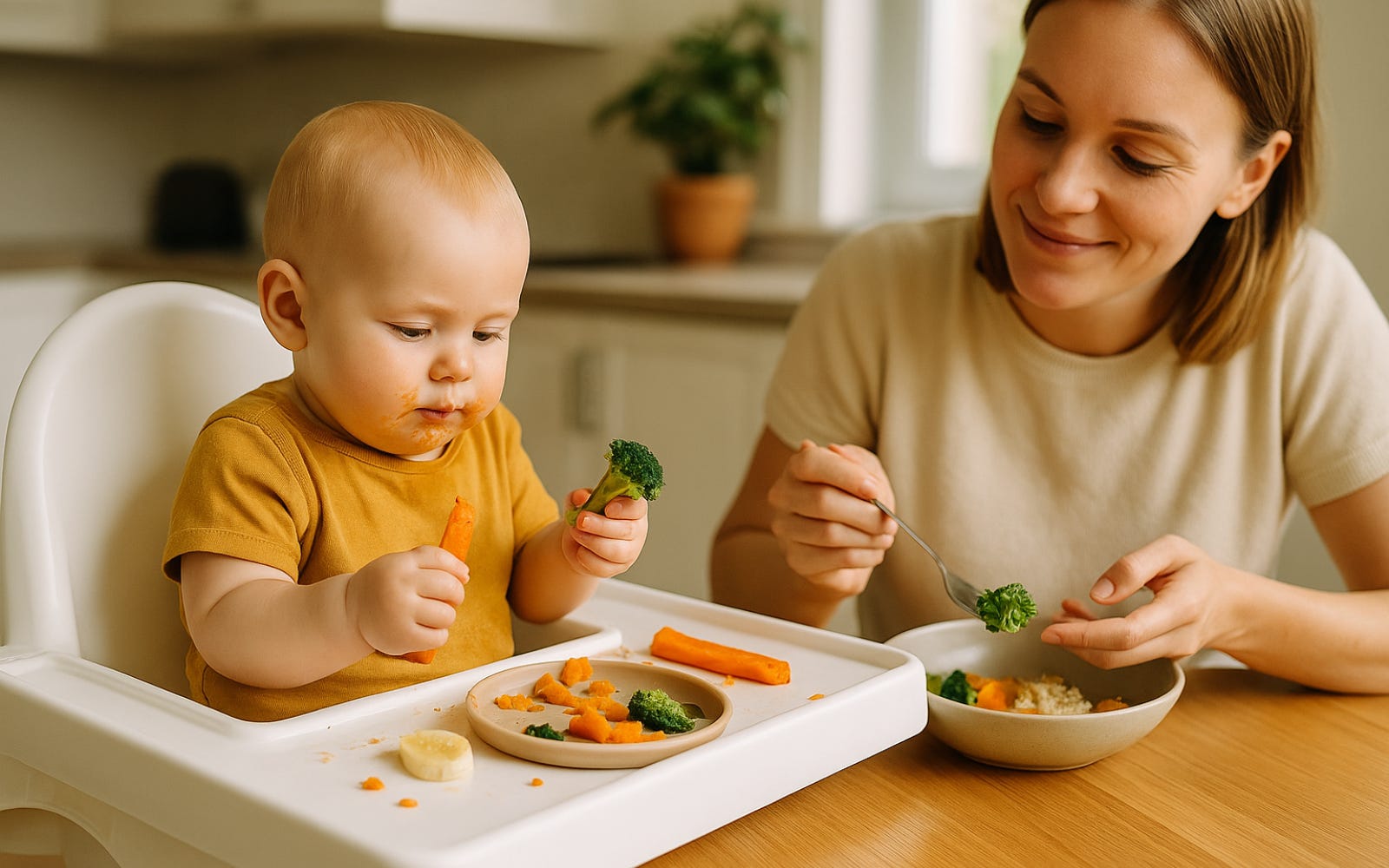
Questions about quantity are some of the most common — and most stressful.
Parents often worry: “Was it too little?” or “Did I overfeed?”
Let’s walk through it together, gently and step by step.
1. How much food should a baby eat?
In the early stages of starting solids, the goal is not to fill your baby up, but to introduce food. This is a time to explore tastes, textures, and new sensations — not to replace milk as the main source of nutrition.
As a rough guide: some sources suggest starting with 1–2 teaspoons and gradually increasing to 1–2 tablespoons per meal.
But remember — this is just a guideline, not a goal. In reality, babies may eat more or less — and that’s completely okay.
What matters most is the experience: the exploration, the interest, and your baby’s comfort.
Until the age of one, breast milk or formula remains your baby’s main source of nourishment. Solids are a complement — not a replacement.
2. How many times a day should I feed my baby?
The number of meals depends on your baby’s age and how familiar they are with solid foods.
Here’s a general guide:
6–7 months — once a day
7–8 months — twice a day
8–9 months and older — 2 to 3 times a day
By 12 months — 3 main meals + 1–2 small snacks
These are not strict rules, just a gentle guideline.
If your baby seems interested in food more often — that’s fine!
If they’re not ready for three full meals yet — that’s okay too.
Keep in mind:
Starting solids is about rhythm and habit, not just fullness.
Over time, your baby will begin to develop a daily routine, where meals find their natural place alongside sleep, play, and time outdoors.
3. What if my baby only eats one spoonful?
This is one of the most common concerns — especially at the very start of weaning.
But here’s something important to remember:
One spoonful is perfectly fine.
In the early weeks, solid foods are not about quantity.
It’s about discovery, play, and new experiences.
The goal is to learn, not to fill up.
Here are a few things that might help:
– Offer food without pressure, in a calm and curious way.
– Let your baby decide how much they’re ready to try.
– Even if the food ends up on the floor — it’s still part of learning.
– Try to trust your baby. Appetite can vary from day to day — and that’s completely normal.
Avoid distractions like cartoons or constant encouragement to “just take one more bite.”
Even a short, peaceful mealtime helps lay the foundation for healthy eating habits in the future.
4. How can I build a daily routine around solids?
When solids are introduced, many parents wonder — how to “fit them in” around naps, breastfeeding/formula, and outings.
Here are a few gentle principles to help guide you:
Start with one solid meal a day — during a time when your baby is awake, calm, not too hungry, and not overtired. Morning or lunchtime can be a good starting point.
Over the following months, gradually add a second and third meal — based on your baby’s interest and your family’s rhythm.
In the beginning, solids usually come after breast or bottle feeding, since milk remains the main source of nutrition.
When you’ve moved to 2–3 meals a day, your daily rhythm might look something like this:
– Morning: milk, then breakfast (e.g., veggies or porridge)
– Midday: milk, then lunch
– Evening: milk, then a light dinner (optional)
The most important thing? Flexibility and observation.
You don’t need a strict schedule — just follow your baby’s cues, and you’ll naturally find the rhythm that works for both of you.
Conclusion
Starting solids isn’t just about spoons and grams.
It’s about exploring food, discovering rhythm, and experiencing new sensations.
Some days will be full of curiosity, others might bring refusals or changes.
And that’s completely normal.
There’s no single “right” amount or perfect schedule.
There’s you, your baby, and your unique pace.
Tune into each other, observe, try things out.
Your child will show you how much and when they need.
How did you build your feeding rhythm?
What worked in your family — and what didn’t?
Share in the comments — your experience might be just the encouragement another parent needs.