

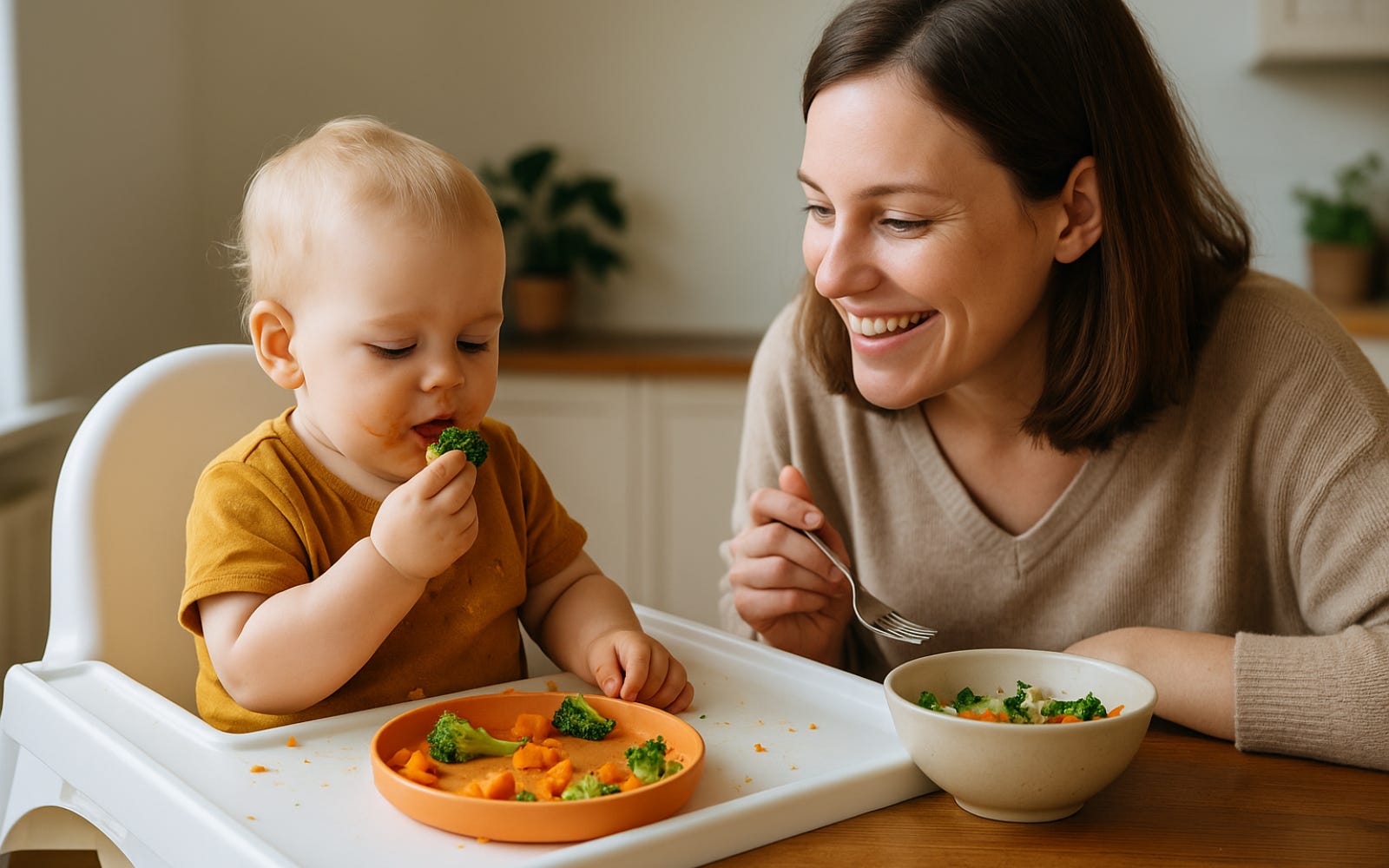
This part is all about mealtime behavior that often worries parents.
Is your baby throwing food? Pushing the plate away? Asking for cartoons during meals?
You’re not alone — these are common, completely normal situations.
Let’s explore what they really mean and how you can gently support your baby through this stage of learning and discovery.
1. Why does my baby throw food or the plate?
Throwing food is not a tantrum or defiance. It’s a normal part of development.
Here’s what might be behind this behavior:
Exploration. Between 6–12 months, babies are discovering the world. They’re learning about weight, texture, and sound. Dropping broccoli on the floor is just as much an experiment as banging a spoon on the table.
Cause and effect. “If I drop this, it falls. And mom looks. Interesting!” It’s learning — not testing limits.
Seeking attention. Sometimes, babies notice that parents react strongly — and repeat the action. Not to be difficult, but because that’s how interaction works at this age.
Tiredness or fullness. When a baby is done eating or getting tired, they may start playing with food — smearing, tossing, or flinging it around.
What can you do?
– Stay calm.
– Avoid a big reaction — no yelling, no turning it into a show.
– Gently say, “If you’re done eating, I’ll take the food away.”
– You can offer a “no-thank-you bowl” — a safe place for your baby to place food they don’t want.
And most importantly: this isn’t bad behavior — it’s learning.
Your response now helps shape how your child relates to food and boundaries later on.
2. What if my baby doesn’t want to eat?
This is one of the most common and stressful concerns for parents.
But the truth is — refusing food is often perfectly normal, especially in the early stages of starting solids.
Here’s what to keep in mind:
Appetite isn’t consistent. It can change from day to day — even throughout the same day. Just because your baby ate everything yesterday and isn’t interested today doesn’t mean something is wrong.
The baby is in control. Starting solids isn’t about controlling how much your child eats — it’s about inviting them to explore. A “no” is still part of the process.
Maybe it’s just not the right time. Your baby might be tired, sleepy, recently had a bottle or breastfed, or just not in the mood. And that’s okay.
Avoid turning meals into a power struggle. Forcing, begging, or distracting with cartoons often leads to stress and unhealthy eating habits down the road.
What can help?
– Offer meals in a calm, predictable setting — no pressure.
– Don’t comment on the refusal: “Not hungry? That’s okay,” and gently put the food away.
– Keep the rhythm: offer food again at the next meal or snack.
– Maintain trust: your child knows how much they need.
If refusal continues for a long time and you’re concerned, it’s worth checking in with a pediatrician or feeding specialist. But the occasional “not today” is completely normal.
3. Should I feed my baby in front of cartoons?
It might seem like an easy fix — you turn on a cartoon, and your baby eats without fuss, without distractions. But it’s important to understand what’s really going on — and the long-term effects.
What happens when a baby eats while watching a screen?
– Their attention is focused on the cartoon, not the food.
– They eat automatically, without noticing taste, texture, or fullness.
– It may seem like your child is eating “better” — but that’s often an illusion of control.
In the long run, this can:
– Weaken the natural connection between hunger and fullness.
– Lead to eating only when there’s stimulation — which can increase the risk of overeating.
– Take away an important experience: exploring food, learning to taste, listening to the body.
But what if my baby won’t eat without the screen?
That’s not a cue to keep distracting — it’s a gentle invitation to:
– Reconsider the timing of meals (maybe they’re simply not hungry yet);
– Let go of expectations and avoid pressure;
– Try eating together — at the same table, offering connection and a calm example.
Mealtime is about more than just food — it’s about connection, presence, and peace.
A screen takes that away. Even if it feels like “nothing else works” right now — with time, you can build new rhythms where meals feel connected again, not controlled.
4. How can I keep mealtimes calm and peaceful?
Sometimes meals feel more like a battlefield:
The child is fussy, throws food, refuses to try anything.
The parent feels stressed, worried, trying to persuade…
And all of this happens at the same table, every day.
But the atmosphere at the table is not a small detail — it’s a key part of your child’s eating habits, which are being shaped right now.
Here’s what helps to keep things calm:
Let go of expectations.
Your child doesn’t have to finish the plate or eat the same amount every day.
The goal is to offer the opportunity to eat, not to force a certain result.
Remove pressure.
Phrases like “just one more bite” or “you’re making me sad” create anxiety, not appetite.
It’s better to offer food — and trust your child to decide.
Create a simple ritual.
For example: wash hands, sit together, turn off screens.
This helps both brain and body get the signal — now it’s mealtime.
Eat together.
Even if you’re not eating a full meal, just sitting nearby with a cup of tea or a small plate of veggies shows support.
Children learn by watching.
Don’t fight — gently shift.
If your child gets upset or overwhelmed, it’s okay to end the meal and try again later. Avoid building tension.
Food is more than nutrients.
It’s an experience — of connection, enjoyment, trust.
By creating a warm, respectful atmosphere, you’re building something your child will carry for life.
Conclusion
A child’s eating behavior is a journey — not a test with right or wrong answers.
Some days they’re eager to try everything.
Other days, they throw the spoon and turn away.
That’s okay. They’re growing, exploring, learning their boundaries.
The goal isn’t to win at the table — it’s to build trust:
trust in your child, in yourself, and in the rhythm you’re creating together.
Small steps. A calm atmosphere. Respect for your child’s feelings.
That’s the real foundation.
Have you ever faced mealtime “battles”?
What helped you stay calm and grounded?
Share your experience in the comments — your story might help another parent feel less alone. ❤️